The most useful thing about the pelamin design ideas 2026 has produced is that almost none of them are about adding more. The dominant shift across Kuala Lumpur and Selangor majlis this year is subtraction — fewer motifs, larger single gestures, more negative space, and one material doing the talking instead of five competing. What follows is not a mood board. It is eight design directions we build, each with the dimensions, the material, the venue it suits and the constraint that usually kills it.

What changed in pelamin design this year
Three shifts sit underneath most of the pelamin design ideas 2026 has thrown up, and they show in almost every brief we receive now:
- Backdrops got taller, not wider. The classic dewan pelamin was a horizontal band — roughly 3.6 m wide, 2.4 m high. Ballroom pelamin is now vertical: 3.5–4.5 m tall panels that read from the back of a 600-pax room, where a low backdrop simply disappears behind the heads of guests standing for photographs.
- Colour dropped in saturation. Champagne, oat, bone, clay, sage and warm greige have displaced the older gold-and-maroon default. Deep colour hasn't gone — it has moved to a single accent, usually in one fabric or one flower.
- Texture replaced ornament. Fluted panels, plaster-finish MDF, rattan weave, moulded resin and pleated fabric are doing the work that carved motifs and appliqué used to do. Texture photographs better under warm ballroom lighting and doesn't date the same way.
Pelamin design ideas 2026: eight directions
1. The sculptural arch
One asymmetric arch — plaster-finish, 3.8–4.2 m tall — with an off-centre floral cluster and nothing else behind it. Reads cleanly in photographs from any angle. Works because the silhouette carries the design, so the floral budget can be small and concentrated.
2. Fluted panel wall
A full-width run of vertical fluted panels in bone or clay, softly uplit from the deck so the ribs throw their own shadow. This is the most photographed direction of the year and the most forgiving — it looks correct with almost no flowers at all.
3. Pelamin bunga segar (fresh-flower wall)
The full floral wall is still the most requested luxury direction, but the smart version is now a partial wall: dense flower across 60% of the backdrop, bare textured surface across the other 40%. It halves the flower count while looking more designed, not less.
4. Suspended cloud
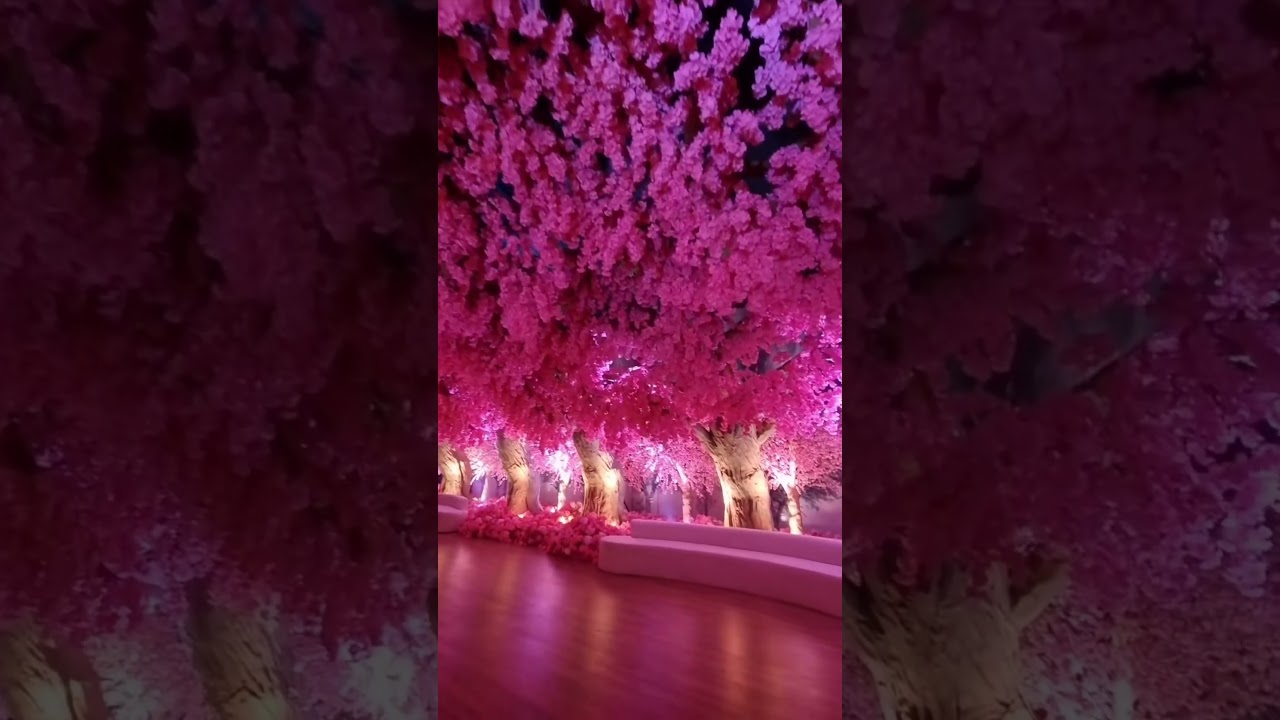
Nothing on the backdrop; the entire installation hangs above the dais — a floral or foliage cloud, 2.5–4 m across, holding at 3–3.5 m above the deck. Dramatic, and the direction most likely to be refused by a hotel. See the rigging section below before falling in love with it.
5. Draped monolith
A single deep-pleated fabric field, floor to 4 m, in one colour, with concealed warm LED behind the pleats. Fast to install, travels well, and the cheapest way to make a low-ceilinged dewan feel taller. Fabric must be fire-retardant certified for hotel use.
6. Garden-terrace pelamin
Built for outdoor and semi-outdoor majlis: timber or rattan structure, potted palms and monstera, heliconia and torch ginger rather than imported soft blooms. Designed to be alive at 2 pm in direct heat, which rules out most European flowers entirely.
7. Heritage-modern
Songket, tenun or batik used as one framed panel — not as an all-over covering — set against a plain modern surround. This is the direction that reads as Malay without reading as dated, and it photographs beautifully because the pattern is contained.
8. Mirror-and-light
Antique or smoked mirror panels behind a slim metal frame, with the floral kept to a low ground bed. Doubles the apparent depth of a shallow stage — genuinely useful in a dewan where the dais can only be 1.8–2.4 m deep.
| Direction | Backdrop height | Best venue | Signature material | Install time |
|---|---|---|---|---|
| Sculptural arch | 3.8–4.2 m | Hotel ballroom | Plaster-finish MDF | 6–8 hrs |
| Fluted panel wall | 3.5–4 m | Ballroom or dewan | Fluted PVC / MDF | 5–7 hrs |
| Fresh-flower wall | 3–4 m | Hotel ballroom | Orchid, anthurium, rose | 8–12 hrs |
| Suspended cloud | Hung at 3–3.5 m | High-ceiling ballroom only | Foliage + preserved stems | 7–10 hrs |
| Draped monolith | Up to 4 m | Dewan, low ceilings | FR-certified pleated fabric | 4–6 hrs |
| Garden terrace | 2.8–3.5 m | Outdoor / poolside | Timber, rattan, live palms | 6–9 hrs |
| Heritage-modern | 3–3.6 m | Dewan or ballroom | Songket / tenun panel | 5–7 hrs |
| Mirror-and-light | 3–3.6 m | Shallow-stage dewan | Smoked mirror, brushed metal | 6–8 hrs |
Hiasan pelamin untuk dewan dan ballroom hotel
The single biggest reason a design gets redrawn is that it was chosen before the venue was understood. Dewan and hotel ballroom are not the same brief.
In a community dewan the ceiling usually sits at 3.5–4.5 m, the stage is shallow, and there is often no rigging capability at all — but you frequently get the venue the night before, which means a longer, calmer build. Vertical illusion is the design job here: tall narrow elements, uplighting, and a mirror or draped direction that pushes the back wall away.
In a five-star KL ballroom — the St Regis, Grand Hyatt, Shangri-La, W, Four Seasons and Mandarin Oriental rooms we work in most often — you gain 5–7 m of clear height and lose almost all of your time. Ballrooms are usually released four to eight hours before the majlis because another function ran that morning. Every one of those rooms restricts what may touch the ceiling.
The rigging rule that decides half the design. Most luxury hotel ballrooms in Kuala Lumpur prohibit drilling or clamping into the ceiling slab. Suspension is limited to designated hard points with a stated safe working load, and anything beyond it must be carried on ground-supported truss or a free-standing frame. A "suspended cloud" that was never approved becomes a floor-standing structure at 48 hours' notice — and it will not look the same. Confirm the rigging policy and the load limit in writing before the concept is signed off, not after.
Two more venue realities worth building into the plan: hotels require fire-retardant certification for fabric and often for foam and timber finishes, and the goods lift dictates your maximum panel size. A 4 m panel that cannot enter the lift has to be fabricated in sections with a joint line — which is a design decision, not a site problem, and it should be drawn from the start.
Flowers that survive a Malaysian wedding day
Malaysia runs at 30–34°C with humidity above 80%. A ballroom is air-conditioned to 21–23°C, but the stage sits under lighting, and outdoor and foyer setups get no help at all. That single fact should drive the flower list more than any palette board.
| Holds up well | Handle with care |
|---|---|
| Mokara & Dendrobium orchid | Hydrangea — wilts fast out of water |
| Anthurium | Peony — short season, cold chain essential |
| Heliconia & torch ginger (bunga kantan) | Garden rose — browns at the petal edge |
| Tuberose (sundal malam) | Sweet pea, lily of the valley |
| Chrysanthemum, gerbera, carnation | Ranunculus, anemone |
| Monstera, ruscus, palm foliage | Delicate imported foliage |
Two practical moves that consistently work: build the fragile flowers into one concentrated cluster placed where the couple sits, so the cold-chain effort is focused; and use preserved or dried material (pampas, bleached ruscus, preserved hydrangea) in the parts of the installation nobody will photograph closely. For outdoor majlis in August and September, plan for haze contingency, and from November to February plan for a genuine wet-weather fallback — a covered alternative, not an umbrella.
From factory drawing to KL ballroom
Custom pelamin structures are drawn here and fabricated in our own factory, which changes the timeline in a way worth planning around. Sea freight to Port Klang runs roughly 28–35 days; air freight is 5–7 days at a materially different cost. Add drawing, approval and finishing and a fully custom piece needs its design locked eight to ten weeks before the majlis.
The build sequence on the day is almost always the same: deck and stage frame first, then structure and panels, then lighting and cabling, then floral last — because flowers installed before the lighting crew is finished get crushed. In a four-hour ballroom load-in, the floral team should be the last crew in the room, not the first. You can see completed builds across ballroom, dewan and outdoor settings in our project showcase, and the full scope we cover on the services page.

Five mistakes that spoil a good pelamin design
- Designing the backdrop before measuring the stage depth. A 4 m backdrop over a 1.8 m deep dais leaves the couple sitting almost against the panel. Depth and height must be decided together.
- Matching the pelamin to the bridal outfit exactly. The couple then disappears into it in every photograph. Contrast — even a half-tone — is what makes them read.
- Ignoring the venue's own lighting. Ballroom chandeliers and house downlights are usually warm and fixed. A cool-white or purple wash fights them and turns champagne fabric grey on camera.
- Buying the flowers by budget rather than by heat tolerance. A cheaper hydrangea wall that collapses by the second hour costs more than a smaller orchid installation that doesn't.
- Leaving rigging approval until after the concept is signed. This is the one that forces a redesign, and it happens most often on suspended and ceiling-heavy concepts.
Once a direction is chosen, the next question is usually what it costs to build — we break that down properly in our Malaysian wedding decoration price guide. If the same venue is also hosting a corporate function, the ballroom constraints described in our corporate event decoration guide apply almost identically.
Questions we get asked most
A dewan pelamin traditionally sits around 3.6 m wide and 2.4 m tall. In a five-star hotel ballroom the backdrop usually needs to grow to 6–9 m wide and 3.5–4.5 m tall, because the room is wider, the ceiling is higher, and the stage competes with a large LED wall behind or beside it.
Rarely without conditions. Most five-star ballrooms do not permit drilling or clamping into the slab and limit loads to designated rigging points with a stated safe working load. Heavier concepts go onto ground-supported truss or a free-standing frame instead.
Mokara and Dendrobium orchids, anthurium, heliconia, torch ginger, tuberose, chrysanthemum and gerbera. Hydrangea, peony and garden roses are the fragile ones and need cold-chain delivery, refrigerated holding and installation as late as the schedule allows.
Eight to ten weeks for a fully custom fabrication, driven by the 28–35 day sea freight window from our factory to Port Klang. Air freight compresses that to 5–7 days but changes the cost significantly.