Custom Wedding Backdrop Design Process Malaysia: From Sketch to Ballroom Install
The custom wedding backdrop design process Malaysia couples rarely see runs through six stages: brief, drawing, mock-up, fabrication, quality check and a night-time install. This is how a piece moves from a mood-board to a finished wall in a Kuala Lumpur ballroom, what is decided at each step, and where the craft either holds or fails.
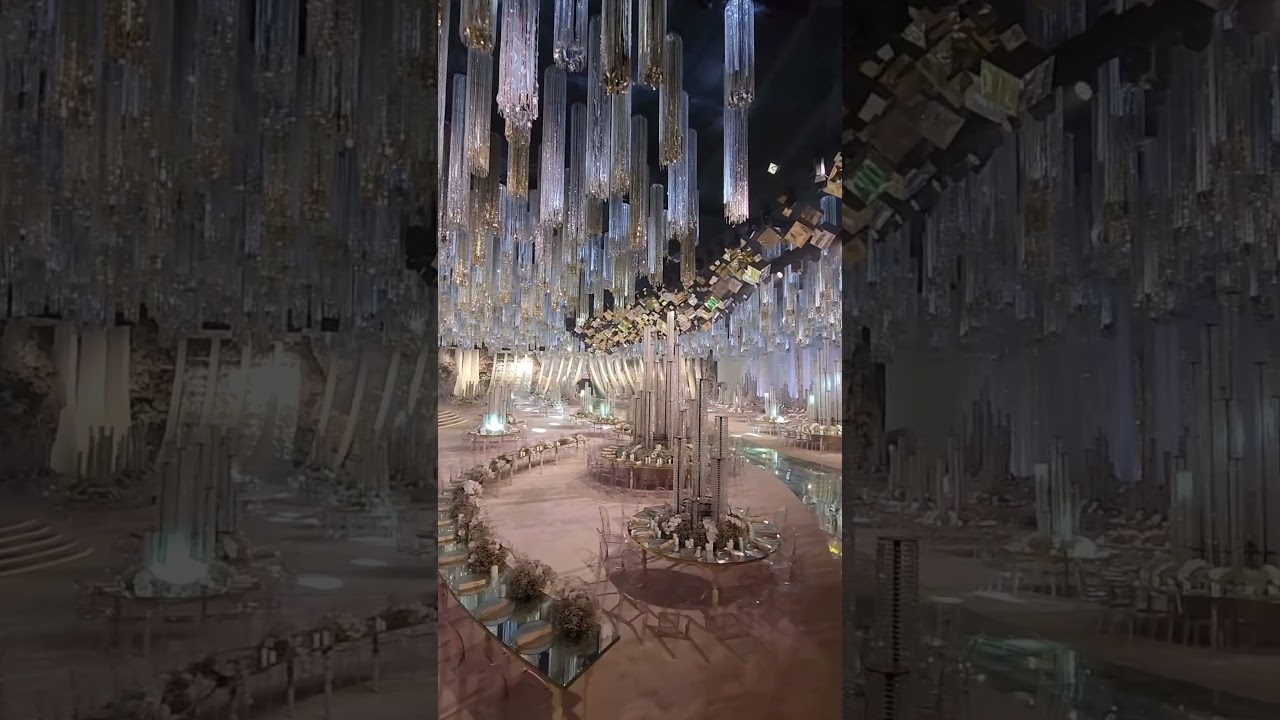
Stage 1: the brief is a photograph, a measurement and a mood
Every custom piece starts with three inputs, and a missing one costs weeks later. First, the reference: two or three images the couple loves, plus one they dislike, which is often more useful. Second, the room: ceiling height, stage depth, pillar positions and the service-lift dimensions, all of which come from a venue visit (our site survey checklist lists what to measure). Third, the light: whether the ballroom runs 2700–3000K warm downlights or flat 5000K tubes, because colour and finish are chosen against the lamp, not against a screen.
We also ask for the photographed angle. A backdrop that must work behind a seated couple at 1.2 m eye level is drawn differently from one that must carry a grand-entrance walk-in from 25 m away. The camera decides which details earn their cost.
Stage 2: the drawing decides what can be built
The design team turns the reference into a dimensioned drawing and a 3D view in the actual room, with the real ceiling and pillars modelled. This is where most creative decisions are made and where most budget is won or lost. A 6 m wide wall is split into panels no taller than 2.1 m, because that is the limit of many hotel service lifts; a curved arch is divided into segments that join behind the decoration; every joint is positioned where a flower cluster or a light fixture can hide it.
We also assign a load figure to each element before anything is cut. Hotel ballrooms generally forbid drilling into the slab and many restrict hanging weight, so the structure must stand on its own base or on ballasted feet (see hotel ballroom decoration rules in Kuala Lumpur). Deciding that at the drawing stage is cheaper than discovering it at load-in.
Pelamin and Chinese banquet backdrops draw differently
A pelamin is read from the front and is often layered in depth, so the drawing carries more relief: carved panels, stepped dais edges and a seating zone for the couple. A Chinese banquet backdrop leans on symmetry and large single motifs such as a double-happiness character, so edge alignment matters more than depth. Same factory, different tolerances. For ideas on the style side see our pelamin design ideas.
The six stages at a glance
| Stage | What happens | Typical duration | What you approve |
|---|---|---|---|
| 1. Brief and survey | References, venue measurements, lighting type | 1–2 weeks | Direction and budget band |
| 2. Drawing and 3D | Dimensioned plan, room render, panel split | 1–2 weeks | Layout, size, colour |
| 3. Mock-up | Material swatches or a small-scale section | 1–2 weeks | Finish and texture |
| 4. Fabrication | Cutting, forming, finishing, assembly | 3–6 weeks | Progress photos only |
| 5. Quality check | Trial assembly, fit and finish inspection, labelling | 2–4 days | Photos or video of the full build |
| 6. Install | Panel assembly on site, lighting, florals | 4–8 hours in the room | Final walk-through |
Durations are indicative planning ranges and move with complexity and the factory calendar. For the freight and shutdown arithmetic, read rental vs custom built wedding decoration; this article stays with the craft.
Stage 3: the mock-up is where finishes are chosen honestly
A render lies slightly about material. Gold on screen is a colour; gold in a ballroom is a finish that reads as brass, champagne or yellow depending on the lamp. We therefore send or show physical swatches: the fabric, the acrylic, the powder-coat sample, a section of the carved panel. For ambitious pieces, a one-metre working section is built so you can see how it catches warm light.
This is also the stage to spend a little to avoid a large mistake. Changing a swatch costs a day; changing a finished wall costs the wall.
Stage 4: how the materials are actually made
Most premium backdrops combine four or five material families. What matters in Malaysia is how each one behaves in 70–85% humidity and in a cold, air-conditioned ballroom.
| Material | How it is made | Humidity behaviour | Best used for |
|---|---|---|---|
| Powder-coated steel frame | Welded, ground smooth, oven-cured coating | Stable; chips on edges if knocked in transit | Arches, rings, structural skeleton |
| Acrylic, 5 mm | CNC or laser cut, edge polished, heat-formed | Stable, but 3 mm sheet can bow above about 900 mm | Lettering, panels, mirrored accents |
| Fabric-wrapped board | Foam or MDF core, stretched fabric, steam-set | Can sag if steamed on site; keep dry | Soft walls, headboards, tufted panels |
| Carved foam or MDF relief | CNC routed, sealed, hand-finished, painted | Needs sealing on all faces; unsealed MDF swells | Pelamin panels, ornate frames |
| Fresh and preserved florals | Mounted on foam or wire on site | Fresh wilts if left out of a cold room | Softening joints and edges |
The quiet craft is in the finishing. Panel edges are ground and re-coated so they do not catch the light as a white line; seams are staggered; fasteners are countersunk and painted to match. None of it is visible in a photograph, which is exactly the point.

Stage 5: the trial assembly nobody sees
Before a piece is crated, it is assembled flat or standing in the factory, exactly as it will stand in the ballroom. Panels are checked for fit, every joint is tested, and each part receives a label that matches the install drawing: wall, panel number, up-arrow. A short video of the assembled piece is shared so the couple sees the real object before it travels.
Packing follows the same logic. Acrylic is interleaved with protective film, powder-coated edges are wrapped, and fragile relief panels are crated flat. The aim is that nothing needs repainting on arrival. The most common avoidable cost on a custom job is transit damage to a painted edge, which is cheap to prevent and slow to repair.
Stage 6: the night-time install, minute by minute
Hotel ballrooms typically hand over a room only after a lunch event clears and need it back before guests arrive for dinner, so the window is tight. A typical sequence for a 6 m backdrop looks like this:
- First hour: floor protection laid, base frames and ballast positioned and levelled against the real floor.
- Second to third hour: labelled panels bolted to the frame in order, seams aligned, back-of-house cabling routed.
- Fourth hour: lighting focused, warm wash tested against the finish, any panel colour correction made.
- Final hour: florals placed last so they stay cold as long as possible, then a walk-through from the guest and camera positions.
Because the parts were fitted at the factory, the install is assembly, not invention. That is why a well-prepared custom wall can still go up in a short ballroom window.

The seven-point approval checklist for couples
- Is the drawing dimensioned for your actual room, with ceiling and pillars modelled?
- Have you handled physical swatches, not only screen colours?
- Is the panel split compatible with the venue's service lift?
- Does the structure stand without drilling the slab?
- Are florals, lights and fixings shown on the drawing?
- Will you see a trial assembly photo or video before shipping?
- Is the install window written into the venue booking?
Mistakes that undermine the custom wedding backdrop design process Malaysia couples go through
- Approving from a render alone. Finish and light change the colour more than software suggests.
- Skipping the panel split. A beautiful 7 m wall that will not fit the lift is not a design.
- Using 3 mm acrylic for tall pieces. It bows in cool, humid rooms; 5 mm is safer above 900 mm.
- Leaving MDF unsealed. Humidity swells exposed faces and edges.
- Steaming fabric on site. It can set off sensitive smoke detectors and sags a fitted wall.
- Adding florals late with no mounting plan. Foam positions should be on the drawing.
- Changing the design after fabrication starts. Edits are free on paper and expensive in material.
- Treating the install as an afterthought. Tight windows reward preparation, not speed.
Cost context: a custom backdrop for a hotel ballroom typically sits from about RM8,000 for a simple fabricated wall to RM40,000 or more for a carved, multi-layer pelamin or stage, before venue fees. These are indicative planning ranges, not a price list, and depend on size, material and access. See how much wedding decoration costs in Malaysia for the wider budget picture.
Frequently asked questions
How long does a custom wedding backdrop take to make?
Allow roughly 8 to 12 weeks from approved drawing to installed piece for a factory-built backdrop, longer around Chinese New Year and other peak periods.
Can I change the design after approval?
Small finish changes before fabrication are usually fine. Once cutting begins, changes to size or structure cost material and time.
Will the backdrop damage the hotel ballroom?
It should not. Properly designed pieces stand on protected bases or ballast and avoid drilling into the floor or ceiling, in line with typical hotel rules.
Do I own the backdrop afterwards?
That is negotiable. Many decorators retain the structure for reuse and offer a lower price in return; ask before you sign.
Planning a custom backdrop for your wedding or event?
We design and fabricate in our own factory, then install across Kuala Lumpur, Selangor and nationwide. Send us your venue, date and a reference photograph, and we will draw it for your room.