Fresh vs Silk vs Preserved Wedding Flowers Malaysia: What Each Really Costs and Survives
Choosing between fresh vs silk vs preserved wedding flowers Malaysia couples can actually rely on comes down to three numbers: cost per arrangement, hours the flowers must look good, and how much heat and humidity they face. Fresh wins on scent and softness but is the riskiest line in a Klang Valley ballroom. Silk wins on repeatability. Preserved wins on a narrow set of hero pieces. Below are indicative RM ranges, a decision table and the mistakes that cost couples the most. Figures are planning ranges, not a price list.

The short answer: mix them by zone, not by couple
Couples usually ask for one material for the whole wedding. Production teams mix. Anything within a metre of guests' faces or the photographer's close-ups, such as the bridal bouquet, the meja pengantin and the aisle edge, earns fresh stems. Anything above head height, behind the pelamin or in the 3–4 m back wall can be silk or preserved without anyone noticing at 8 m viewing distance. That single decision usually moves a floral budget by 25–45% with little visible change. Before you commit, read our tropical wedding flowers in Malaysia guide for the stem-level view, and use this page for the money and risk view.
What each material is, in supplier terms
Fresh
Cut stems conditioned in water or foam. In Malaysia most premium blooms are air-freighted (roses and lisianthus from Kunming, Ecuador and the Netherlands via wholesalers in Kuala Lumpur), while orchids, ginger and foliage are local. Price swings hard around Chinese New Year, Valentine's Day and Hari Raya, and landed cost can move 20–40% for the same stem in a fortnight.
Silk (artificial)
Fabric or moulded-latex blooms on wire stems. Quality runs from RM3 to RM60 per stem. Real-touch latex peonies, roses and orchids photograph close to fresh; thin polyester ones read as plastic on camera and under warm 2700–3000 K ballroom lighting.
Preserved
Real flowers glycerine- or resin-treated and dyed, usually roses, hydrangea, gypsophila and moss. They look natural and need no water, but they are brittle, they fade in direct sun, and they can soften in prolonged humidity above 80%, so they suit air-conditioned rooms and short windows rather than open-air garden sets.
Fresh vs silk vs preserved wedding flowers Malaysia: cost and risk compared
This table assumes a mid-size hotel ballroom wedding of around 300 guests. Ranges are indicative and vary by stem, season and design density.
| Item | Fresh | Silk (good quality) | Preserved |
|---|---|---|---|
| Bridal bouquet | RM350 – 1,200 | RM250 – 800 (keepsake) | RM400 – 1,400 (keepsake) |
| Round-table centrepiece | RM120 – 450 | RM80 – 300 (reusable) | RM150 – 500 |
| Aisle arrangement, per side | RM400 – 1,500 | RM300 – 1,100 | RM450 – 1,600 |
| Pelamin or stage floral wall, per sqm | RM900 – 2,800 | RM500 – 1,600 | RM1,100 – 3,200 |
| Hanging ceiling installation | RM6,000 – 25,000+ | RM4,000 – 14,000 | RM7,000 – 22,000 |
| Looks good for | 6–10 hours indoors | Indefinitely | Weeks to months, away from sun |
| Main risk in Malaysia | Heat wilt, supplier shortage, price spikes | Plastic look, dust, fire rating | Brittle, fading, humidity |
| Reuse value | None | High across 3–10 events | Low to medium |
Notice that silk is not always the cheap option. A high-end real-touch hanging installation can cost close to a fresh equivalent once you add labour, wire armature and fire-retardant treatment. Silk becomes cheaper when you reuse it, which is why rental vs custom built wedding decoration is the sister decision to this one.

What heat and humidity do to each option
Klang Valley ballrooms are air-conditioned to 21–24°C, but the real stress arrives before and after: the loading dock, the lift lobby, the corridor with open doors, and the outdoor entrance. Humidity of 75–90% outside and a 4–6 hour pre-event build window is where fresh stems start dropping heads.
- Fresh roses and lisianthus cope indoors for the length of a dinner if they are properly hydrated and kept out of the sun. They struggle at outdoor garden receptions in the afternoon, where 32–34°C turns a bouquet limp in under two hours.
- Orchids (dendrobium, phalaenopsis) are the dependable fresh choice: they handle heat and last a full day. Local supply also keeps them off the air-freight price roller coaster.
- Peonies, ranunculus and sweet peas are often requested from Pinterest and are the worst performers in a tropical room. Silk or real-touch versions are usually the honest answer.
- Preserved hydrangea and gypsophila hold shape in cold ballrooms but can absorb moisture near lake-facing or open-air venues.
- Silk is unaffected by climate, but dust and direct lights can show seams and glue.
Bunga segar, bunga artificial dan bunga kering: apa yang sesuai untuk majlis perkahwinan
For a Malay majlis perkahwinan, the same logic applies with a cultural twist. Hand bouquets (bunga tangan), bunga manggar and the fresh melur or kenanga strands used in adat are best kept fresh because scent and symbolism matter. The pelamin backdrop, ceiling drape accents and side panels can be artificial or preserved, because they are far from the guests and the pelamin may be reused across several sittings. In a dewan with 5000 K tube lighting, avoid pale preserved pinks that bleach to grey; deeper tones and greens hold up better. For tray styling, see our hantaran decoration cost breakdown.
Production constraints nobody mentions until load-in day
- Fire rating. Many hotels ask for flame-retardant or fire-rated artificial foliage in hanging installations. Untreated silk can be refused at the dock. Confirm in writing; see hotel ballroom wedding decoration rules in Kuala Lumpur.
- Foam and water. Floral foam on a carpeted stage needs trays and plastic sheeting; some venues ban it. Preserved and silk avoid the issue.
- Weight. A wet fresh hanging installation can be two to three times heavier than silk, which changes the rigging-load calculation.
- Delivery window. Fresh stems arrive the day before at best. A flower shortage on a long weekend leaves no time for substitution; silk and preserved can be produced weeks ahead in the workshop.
- Strike. Fresh is discarded or donated; silk is boxed and reused, which affects labour and storage.
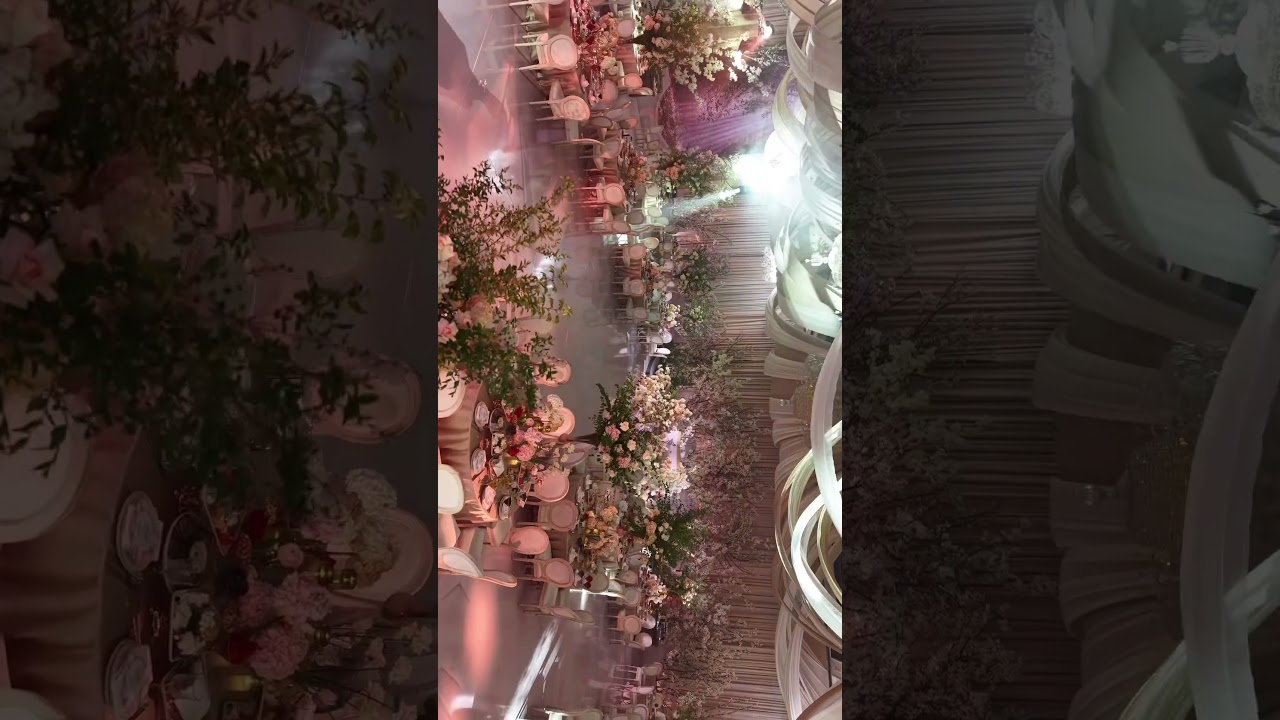
A decision table by wedding type
| Situation | Best material mix | Why |
|---|---|---|
| Hotel ballroom, 2–4 week lead time | Fresh at tables and bouquet, silk back wall | Controlled climate; the visible items stay fresh |
| Dewan or outdoor garden, afternoon | Silk or preserved structure, orchids only for fresh | Heat and no climate control |
| Budget under RM15,000 for flowers | Silk volume plus fresh bouquet and entrance | Most visual density per ringgit |
| Two weddings or sittings in one week | Reusable silk with fresh top-up | Spreads the structure cost |
| Keepsake priority | Preserved or silk bouquet, fresh for the day | Bouquet survives for photographs afterwards |
| Long weekend or festive season | Lock fresh orders early or shift to silk | Import prices and supply swing |
Eight mistakes that cost couples money
- Specifying peonies for a dewan afternoon. They collapse; swap to real-touch or ranunculus-look silk.
- Buying silk by the photo. Ask for a physical sample under warm light before you pay.
- Comparing quotes without material lines. A quote that does not state fresh, silk or preserved per item is not comparable.
- Paying for fresh in places no one sees. Ceiling, back wall and sides can be silk.
- Forgetting the substitution clause. Ask what happens if a named bloom is unavailable.
- Ignoring fire-rating requests. It can force a rebuild on the day.
- Treating preserved as maintenance-free. Keep it away from open doors, sun and rain.
- Not planning reuse. If the arrangements go back to a store, ask who stores, cleans and reinstalls them.
How to brief your decorator on materials
Send three things: the venue and date, a guest count, and a ceiling-versus-table priority list. Ask for the quote to be itemised by zone with the material named on every line, plus a fresh-stem substitution clause and a fire-rating statement. If you are comparing two suppliers, use the same zones and the same questions from what to ask a wedding decorator before booking.
Frequently asked questions
Is silk cheaper than fresh flowers for a Malaysian wedding?
Often 25–45% cheaper for large floral walls and ceilings, but not always. Real-touch silk with fire-retardant treatment and wire armature can approach fresh pricing. Silk wins most when it is reused.
Do preserved flowers last in Malaysian humidity?
In an air-conditioned room, yes, for weeks. In open-air venues or sustained humidity above 80% they can soften, curl or discolour, so keep them indoors and away from sun.
Can I mix fresh and artificial flowers in one arrangement?
Yes. Silk provides volume and structure, and fresh stems sit at the focal points. This hybrid approach is common in hotel ballroom builds because it reads as real from a few metres.
How far ahead should I order fresh wedding flowers in Malaysia?
Confirm designs 4–6 weeks before, lock imported stems 2–3 weeks before, and expect final delivery the day before or the morning of the event. Festive periods need earlier locking.
Not sure which mix suits your venue?
Tell us the venue, date and guest count and we will map fresh, silk and preserved by zone with an itemised range. We design and fabricate in our own factory and serve Kuala Lumpur, Selangor and nationwide. See our showcase or our services first if you want to see the work.