Hari Raya Decoration Ideas Malaysia 2027: Eight Installation Concepts for Malls, Hotels and Offices
These Hari Raya decoration ideas Malaysia malls, hotels and corporate offices can use for 2027 are shaped by an unusual calendar. Ramadan is expected to begin around 8 February 2027, only two days after Chinese New Year, and Hari Raya Aidilfitri is expected around 10 March 2027. Below are eight installation concepts, a motif guide, the CNY-to-Raya changeover problem, and the production calendar that decides what can still be built in time. Ringgit figures are indicative planning ranges, not a price list, and festival dates are subject to the official moon-sighting announcement.
What is changing in Raya styling for 2027
The kampung nostalgia theme is not going anywhere; it is the emotional core of balik kampung season. What is changing is how it is built. Four shifts in Klang Valley briefs explain why the strongest Hari Raya decoration ideas Malaysia venues are commissioning for the coming Syawal look different from five years ago:
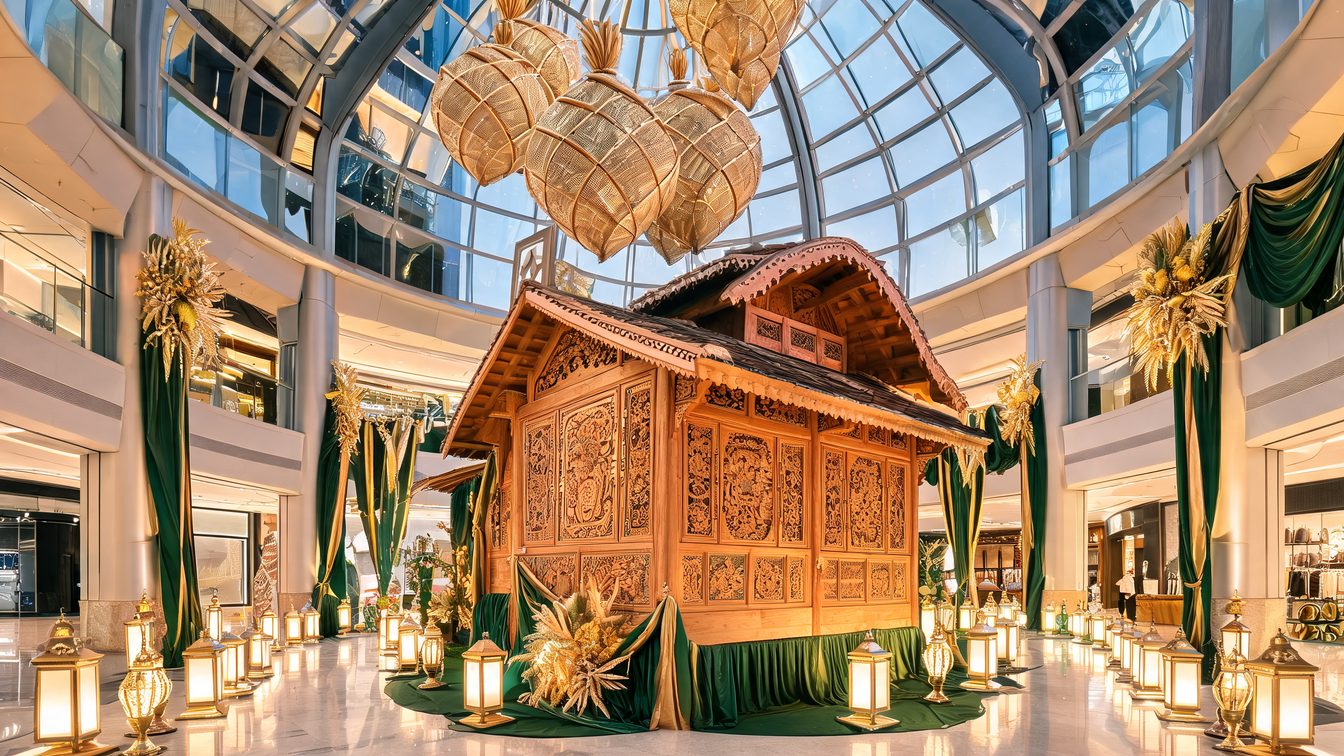
- Architecture instead of props. Instead of a scatter of fibreglass ketupat and printed bamboo, premium malls are asking for one proper structure: a rumah kampung facade with real proportions, tiang (stilts), tangga (stairs) and carved panels in the awan larat style. One credible building photographs better than forty small props.
- A softer green. Emerald and gold remain the base, but sage, ivory, pandan green and burnished brass are replacing the saturated lime greens of earlier years. Songket and batik are used as pattern language on panels and runners, not only as draped fabric.
- Light as the main material. Ramadan footfall peaks after berbuka puasa, which falls at roughly 7.20pm to 7.30pm in Kuala Lumpur in February and March. Most people will see the installation at night, so pelita arrays, lantern walks and warm 2700K to 3000K wash matter more than daylight finishes.
- Reusable cores, seasonal skins. Timber-look frames built in steel or treated plywood are being designed to take a new skin each year, the same logic we set out in rental vs custom-built decoration.
Eight Hari Raya decoration ideas Malaysia venues are planning
1. The rumah kampung facade
The atrium hero. A two-storey facade, 8 to 12 metres wide, with a serambi (front verandah) visitors can walk onto. The detail that separates a convincing house from a theme-park one is the roof: a steep bumbung panjang with carved sobek (fascia) boards and a tebar layar gable. Build in fire-rated plywood with a timber-grain finish; real hardwood is heavy, expensive and hard to move through a loading bay. Indicative range: RM60,000 to RM250,000 depending on size and carving density.
2. The pelita walk
Rows of pelita lining a path recall malam tujuh likur, the tradition of lighting oil lamps on the last odd nights of Ramadan. Indoors, every flame must be LED; no mall or hotel will approve kerosene or oil pelita, and few will approve candles. Use bamboo-look or brass housings with warm, flicker-effect LED cores at 300 to 600mm spacing. RM8,000 to RM40,000 for a 20 to 60 metre run.
3. The suspended ketupat canopy
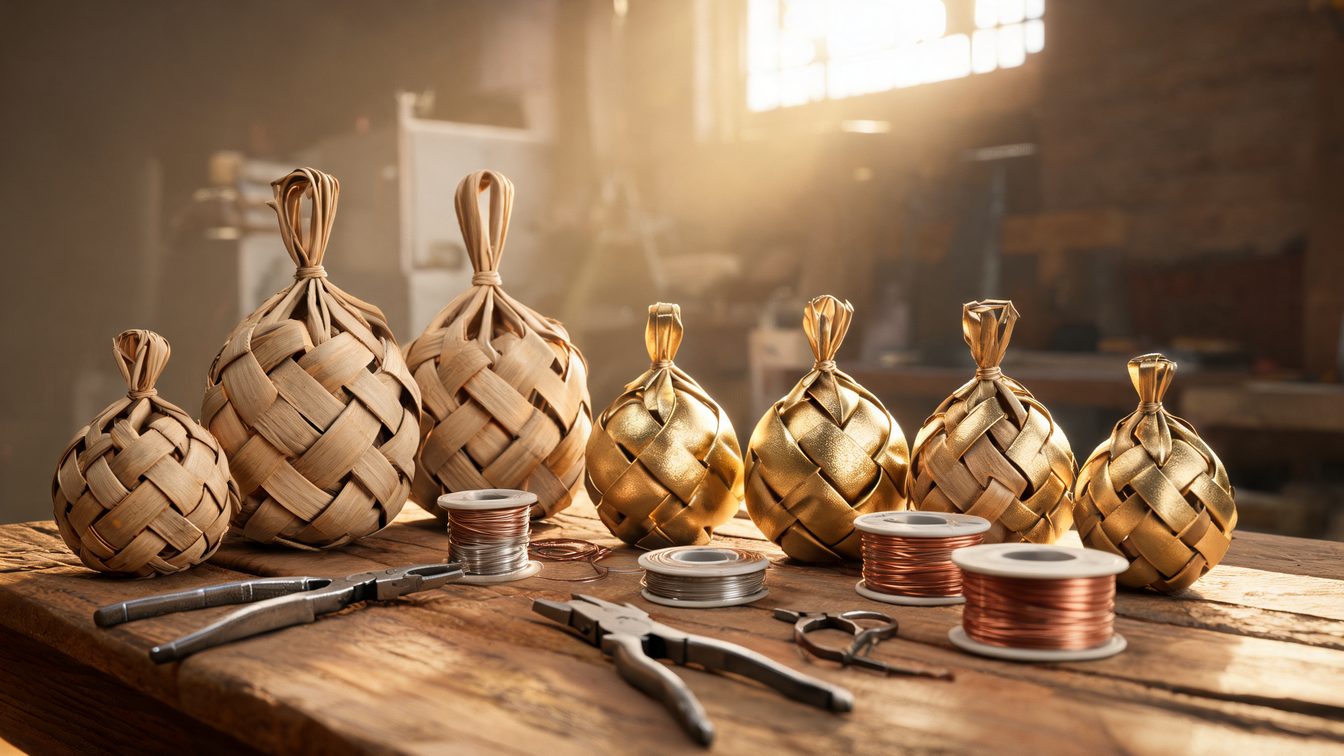
Hundreds of ketupat at different heights over an atrium or ballroom. Mix sizes (300, 600 and 900mm) and two or three materials: woven rattan, brushed gold metal and translucent acrylic that can be lit from within. This is a rigging job first and a decoration second; see the installation notes below. RM15,000 to RM80,000.
4. Bunga manggar arches
Bunga manggar were traditionally made from shredded coconut palm fronds and placed at the entrance of a wedding or feast house. Reinterpreted in gold metallic film or laser-cut acrylic, they make an elegant entrance arch or a column treatment for a hotel porte-cochère. RM5,000 to RM30,000.
5. The restrained luxury-hotel lobby
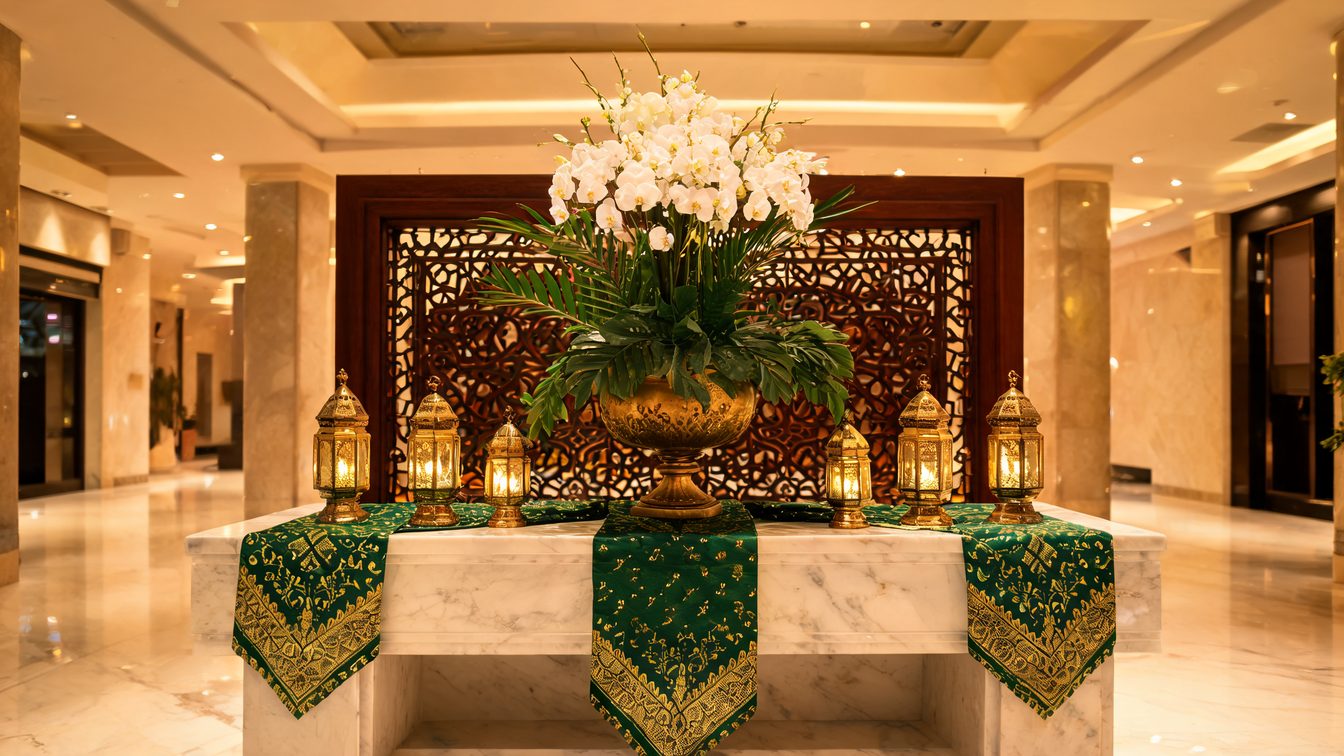
Five-star lobbies such as those at the St Regis, Mandarin Oriental and Four Seasons in Kuala Lumpur rarely want a kampung house. They want one statement: a tall orchid and palm arrangement in a brass urn, a songket runner, a carved screen and a cluster of brass lanterns. The floral is the recurring cost; plan for a weekly refresh through Syawal at RM2,500 to RM6,000 each time, on top of RM8,000 to RM25,000 for the fixed pieces. We covered the wider design principles in hotel lobby interior design ideas Malaysia.
6. The wau bulan feature wall
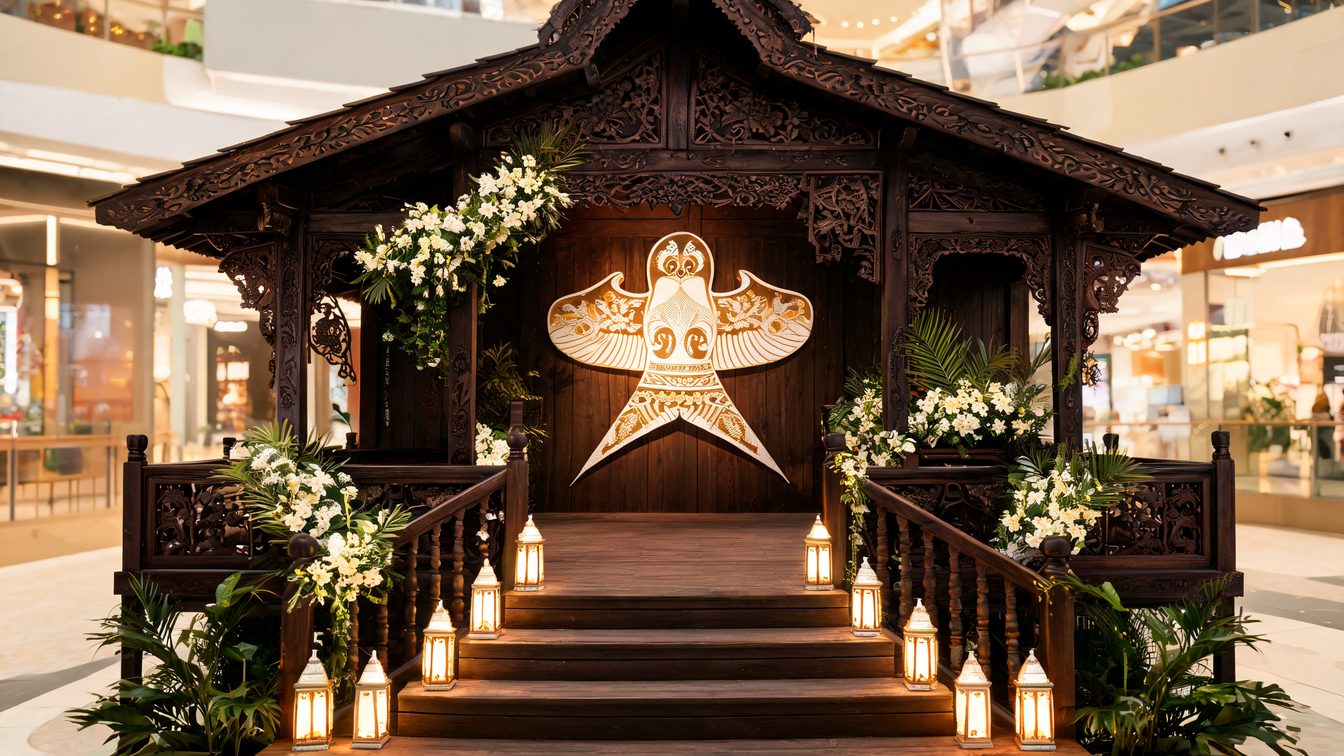
The crescent-tailed kite of Kelantan is one of the few Raya motifs with no religious sensitivity attached, which makes it ideal for brand-led spaces. Scale it to 2 to 3 metres, back-light the cut-outs, and pair it with a songket-pattern panel. RM6,000 to RM25,000.
7. The corporate rumah terbuka
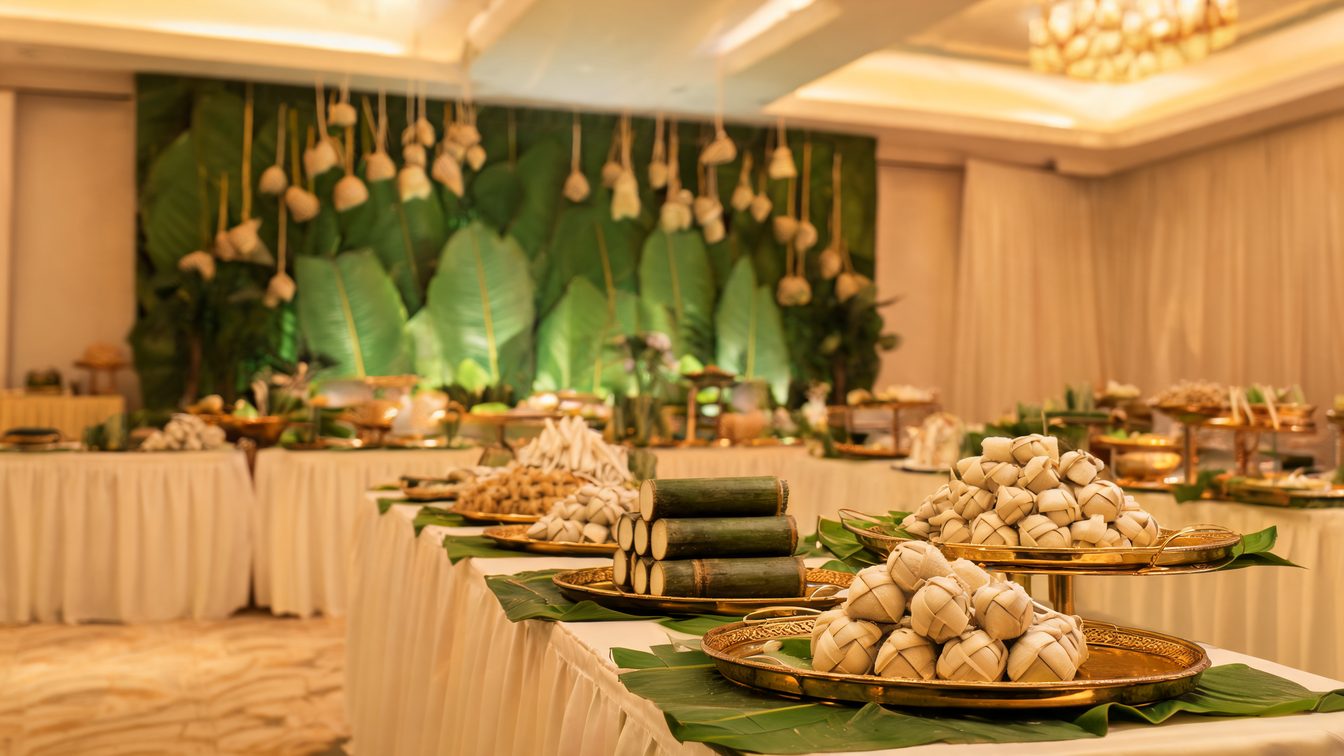
Company open houses in hotel ballrooms or office cafeterias need a backdrop for the group photo, styled buffet risers and a clear welcome point for the CEO line. A woven pandan or mengkuang panel wall with hanging ketupat, brass dulang on the buffet and banana-leaf runners gives you all three. RM8,000 to RM35,000 for a 200 to 500 guest event.
8. The serambi photo spot
The installation that does most of a mall's social-media work. A raised timber verandah with three or four steps, pelita along the treads, a wau or carved panel behind and floral sprays either side. Keep the step risers at 150 to 175mm with a non-slip finish and a handrail; families in baju kurung and kids in sampin will be climbing it all day. RM15,000 to RM60,000.
The eight ideas at a glance
| Idea | Best venue | Typical footprint | Display life | Indicative RM |
|---|---|---|---|---|
| Rumah kampung facade | Mall atrium | 8–12m wide | Ramadan to end of Syawal | 60,000–250,000 |
| Pelita walk | Mall, hotel driveway | 20–60m run | Full season | 8,000–40,000 |
| Suspended ketupat canopy | Atrium, ballroom | Ceiling grid | Full season | 15,000–80,000 |
| Bunga manggar arches | Entrances, porte-cochère | 3–5m arch | Full season | 5,000–30,000 |
| Luxury lobby statement | Five-star hotel lobby | Centre table plus screen | Florals weekly | 8,000–25,000 + florals |
| Wau bulan feature wall | Office, retail, lobby | 2–3m wall | Full season | 6,000–25,000 |
| Corporate rumah terbuka | Ballroom, cafeteria | Backdrop plus buffet | One day | 8,000–35,000 |
| Serambi photo spot | Mall concourse | 4 x 3m | Full season | 15,000–60,000 |
Hiasan Hari Raya Aidilfitri: motif dan maknanya
Good hiasan Hari Raya reads as Malay and Malaysian, not as generic "Eid". The difference is in the motifs you choose and how carefully you use them.
| Motif | What it is | How to use it well | Watch-out |
|---|---|---|---|
| Ketupat | Rice cooked in a woven palas or coconut-leaf casing | Suspended in clusters, at mixed scale | Fresh-leaf ketupat browns within days indoors; use it on food tables only |
| Pelita | Oil lamp of malam tujuh likur | Lines, steps, window ledges | LED only; no open flame in malls or hotels |
| Bunga manggar | Shredded palm-frond festive ornament | Entrance arches, column wraps | Metallic film sheds; specify fire-rated material |
| Wau bulan | Kelantan crescent kite | Feature walls, back-lit panels | Over-used flat prints look cheap; give it depth |
| Songket | Gold-thread woven textile | Runners, panel inlays, pattern graphics | Real songket is costly; printed lookalikes need good resolution |
| Ukiran kayu (awan larat, pucuk rebung) | Malay woodcarving motifs | Screens, fascia boards, gable ends | CNC-cut acrylic in brown reads as plastic under spotlights |
| Khat (calligraphy) | Arabic or Jawi script | Only where the text is checked and placed respectfully | Never at floor level, on seating or near washrooms |
If a design includes any religious text, have the exact wording checked by someone qualified before fabrication, and place it at or above eye level. It is the one detail that can turn a well-meant installation into a complaint.
The 2027 problem: Ramadan begins as Chinese New Year ends
In a normal year a mall strikes its CNY display after Chap Goh Mei and has weeks before Ramadan. In 2027 the dates collide: Chinese New Year on 6 February, Ramadan expected from around 8 February, Chap Goh Mei on 20 February, and Hari Raya Aidilfitri expected around 10 March. Malaysians have a word for festive seasons that overlap, Kongsi Raya, and 2027 will test every facilities team. There are three workable positions:
- Split the space. CNY in one atrium, Ramadan and Raya in another, from early February. Works for large malls with two court areas; it doubles install crews in the same January week.
- Staged changeover. Keep CNY to Chap Goh Mei, strike overnight, and install Raya from around 21 to 24 February. That gives roughly two and a half weeks before Raya, but Raya displays normally run through the month of Syawal, so the display still earns six weeks of footfall.
- One base, two skins. Build a neutral timber-and-brass structure that takes a red and gold skin for CNY and a green and ivory skin for Raya. It is the most efficient option if the design starts now; it is not something that can be retrofitted in February.
We described the CNY side of this calendar in our Chinese New Year decoration ideas Malaysia post. The two briefs should be planned together.
Production calendar for a Raya 2027 installation
The constraint is not Raya itself but the Chinese New Year factory shutdown. Factories in China typically close from late January to late February 2027, which is exactly when Raya pieces would otherwise be finishing. Anything fabricated there has to be on a ship before the holiday.
| When | What has to happen |
|---|---|
| Late Nov to early Dec 2026 | Concept, venue survey, design sign-off and deposit |
| December 2026 | Fabrication of structures, ketupat, carved panels and lanterns |
| By mid-January 2027 | Sea freight departs China (around 25 to 35 days to Port Klang, plus 3 to 7 working days for customs and haulage) |
| Mid to late February 2027 | Arrival, local finishing, trial assembly in our warehouse |
| From around 8 Feb (split) or 21–24 Feb (changeover) | Overnight installation in the venue |
| Around 10 March 2027 | Hari Raya Aidilfitri (expected) |
| Early to mid April 2027 | End of Syawal open-house season; strike and storage |
Locally built pieces can be made later, but expect to pay more for the same item; local workshop builds generally cost more than factory-made pieces shipped by sea. For a deeper look at how a custom piece moves from drawing to venue, see our custom backdrop design process.
Installation realities in malls and hotels
- Overnight windows. Mall atrium work usually happens between closing and opening, roughly 10.30pm to 8am. A rumah kampung facade typically needs two to three nights, so everything is pre-assembled in modules small enough for the goods lift.
- Fire-rated materials. Fabrics, palm-look films and timber-look boards should come with flame-retardant certificates; mall management will ask for them before approving the install.
- Rigging weight. A 600mm rattan ketupat weighs around 1 to 1.5kg once wired; 200 of them with cable and hardware can approach 300 to 400kg spread over the ceiling. Only the venue's approved rigging points can take it, and the plan needs sign-off.
- Humidity. Untreated rattan and dried palm absorb moisture in Malaysia's climate and can sag over a six-week display. Seal natural materials and specify wire cores.
- Light at night. Since peak footfall follows berbuka, test the lighting after dark before handover. Our lighting cost guide explains why warm wash is worth its line item.
- Crew scheduling in Ramadan. Many installers will be fasting. Schedule the heaviest lifting after berbuka or in the early night shift, and allow time for prayer breaks. It is basic respect, and it keeps the crew safe.
Seven mistakes we see in Raya decoration
- Starting design in January for a China-fabricated piece, and running into the CNY shutdown.
- Using fresh-leaf ketupat as display décor; they brown and smell within a few days.
- Specifying real pelita flame indoors and getting the install rejected on the night.
- Placing religious calligraphy at floor level or on surfaces people lean against.
- Designing for daylight when most visitors arrive after berbuka.
- Forgetting the CNY strike: two crews, one loading bay and one night is not a plan.
- Building a photo spot without handrails or non-slip treads in a busy concourse.
If you are planning a Raya 2027 installation, our team designs, fabricates in our own factory and installs across KL, Selangor and nationwide. Browse our showcase for recent projects, see our event, floral and interior design services, or read how we approach Malay staging in pelamin design ideas 2026.
Frequently asked questions
When is Hari Raya Aidilfitri 2027?
Hari Raya Aidilfitri 2027 is expected around 10 March 2027, with Ramadan expected to begin around 8 February 2027. The exact date is confirmed by the official moon-sighting announcement.
When should Raya decorations go up in a mall or hotel?
Most malls install at the start of Ramadan and keep the display through Syawal. In 2027 many venues will install after Chap Goh Mei on 20 February, because Ramadan overlaps the Chinese New Year display.
Can CNY and Raya decorations be displayed together?
Yes, if they occupy separate zones. Large malls can split two court areas, or design one neutral base structure that changes skin from red and gold to green and ivory.
How early should we order custom Raya decorations for 2027?
For pieces fabricated in China, sign off the design by early December 2026 so items ship by mid-January, before factories close for Chinese New Year.
Planning your Raya 2027 installation?
Send us your venue, available space and install window and we will return a concept direction with an itemised range. There is still time to fabricate for Syawal if we start before December.